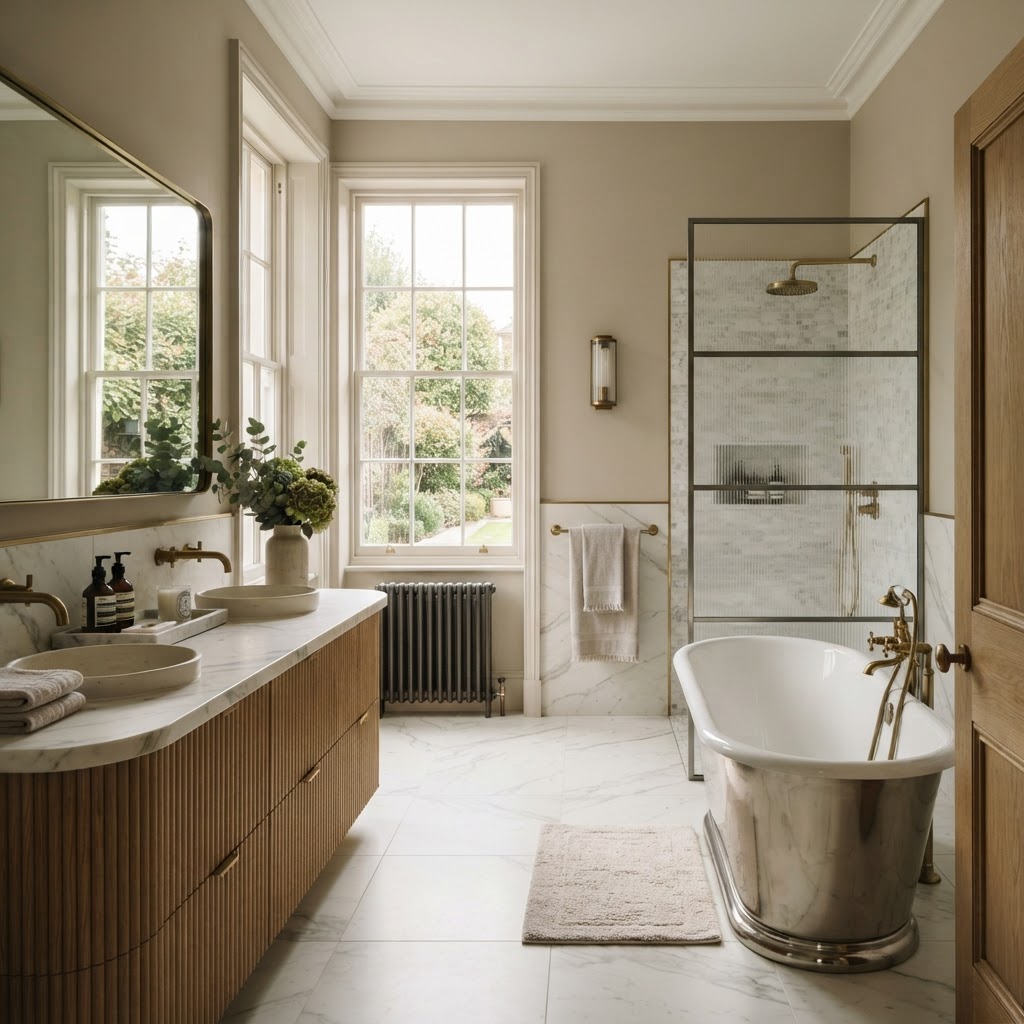
Why the Bath You Choose Changes Everything
There is a moment, usually somewhere between stripping back a tired bathroom and staring at a blank canvas of white plaster and bare pipework, when the full weight of possibility lands. The bath you choose will not simply be a vessel for hot water. It will become the centrepiece of one of the most personal rooms in your home — a daily ritual object, a focal point of design, and if chosen well, a piece that makes the entire bathroom feel considered, cohesive, and quietly extraordinary.
In 2026, the appetite for bathrooms that genuinely deliver a spa-like experience at home has never been stronger. Across Gloucestershire — from elegant period townhouses in Cheltenham to barn conversions deep in the Cotswolds — homeowners are investing in bathrooms that feel as thoughtfully designed as their kitchens and living spaces. At Dajon Interiors, our bespoke bathroom showroom in Gloucester sits at the heart of this movement, guiding clients through one of the most nuanced and rewarding design decisions they will make.
This guide covers everything you need to know about choosing the perfect bath in 2026: materials, shapes, sizing, installation styles, and the design principles that separate a truly exceptional bathroom from one that merely functions.
The Four Principal Bath Styles — and When to Choose Each
1. Freestanding Baths
The freestanding bath remains the gold standard of luxury bathroom design, and for good reason. Positioned away from the wall, it commands the room, drawing the eye and anchoring the entire scheme around it. In large bathrooms — the kind frequently found in Cotswolds farmhouses, Victorian villas in Cheltenham, or new-build executive homes across Gloucestershire — a well-chosen freestanding bath can be as architecturally impactful as a piece of sculpture.
The key consideration is proportion. A freestanding bath that is too small for the room looks lost; one that is too large overwhelms the space and makes it feel cluttered. As a rule, you should have at least 600mm of clear floor space on all accessible sides of the bath. In most standard UK bathrooms, this means a freestanding bath works best where the room is at least 2.4 metres wide and 3 metres long.
2. Built-In and Inset Baths
The built-in bath — set into a tiled or panelled surround — offers a clean, architectural quality that suits both contemporary and more traditional schemes. When executed with precision, a built-in bath feels deliberate and substantial, particularly when the surround is finished in a material that echoes the wider bathroom palette: large-format stone-effect porcelain, polished Carrara marble, or richly veined Calacatta surfaces.
Built-in baths also offer excellent practical benefits. The surround creates a natural shelf for bathing products, candles, and accessories, and the enclosed design is easier to keep clean than the floor space around a freestanding piece. For family bathrooms where the bath sees daily use, this can be a significant advantage.
3. Back-to-Wall Baths
The back-to-wall bath offers a compelling middle ground. The bath itself sits flush against the wall, with the visible sides finished in a complementary panel — often matching the floor or wall tiling — while retaining the clean lines and visual clarity of a freestanding design when viewed from the front. This style works particularly well in bathrooms with an alcove or recessed wall, where the bath can be framed naturally by the architecture.
4. Corner and P-Shaped Baths
For bathrooms where a shower is also required but space is at a premium, the P-shaped bath — which flares at one end to create a wider showering area — remains an intelligent solution. While not the most glamorous option, when specified in a quality material and paired with a well-designed shower enclosure, it can deliver genuine versatility without compromising the feel of the room.
Materials: The Detail That Defines Quality
The material from which a bath is made has a profound effect on its look, feel, longevity, and thermal performance. In 2026, the luxury end of the market has moved decisively beyond standard acrylic, with stone resin and solid surface materials now firmly established as the preferred choice for high-end bathrooms.
Stone Resin
Stone resin baths are cast from a composite of natural minerals and high-quality resins, producing a material that is dense, weighty, and exceptionally warm to the touch. Unlike acrylic, which flexes slightly underfoot and can feel hollow, a stone resin bath feels entirely solid — a quality that communicates luxury before a single tap has been turned. Stone resin also retains heat superbly, keeping bathwater warm for longer and enhancing the overall bathing experience.
The aesthetic possibilities of stone resin are considerable. The material can be cast in smooth, matte finishes that suggest natural stone, or in high-gloss white that reads as clean and contemporary. Many of the most architecturally striking bath shapes available today — deep oval soakers, angular double-ended designs, asymmetric forms — are only achievable in stone resin or similar composite materials.
Acrylic
High-quality acrylic baths, particularly those with reinforced bases and thicker walls, remain a perfectly respectable choice, particularly for family bathrooms or projects where budget is a consideration. The key is to specify the thickest gauge available and to look for reinforced bases that eliminate any flex. Acrylic baths are available in a far wider range of shapes and sizes than stone resin, and they are considerably lighter — an important practical consideration in upper-floor bathrooms where structural loading may be a concern.
Copper and Stainless Steel
For bathrooms with an artisan, industrial, or heavily material-led aesthetic, copper and brushed stainless steel baths offer something genuinely distinctive. Both materials develop a patina over time, and both have excellent heat-retention properties. They are not to every taste, but in the right setting — a converted Gloucestershire barn with exposed beams, for example, or a dramatic all-dark bathroom scheme — they can be extraordinary.
Sizing and Ergonomics: Getting the Fit Right
One of the most overlooked aspects of bath selection is ergonomics. A bath that looks beautiful in a showroom may be deeply uncomfortable to actually lie in if the internal dimensions, backrest angle, and depth are not suited to the user. Before committing to any bath, we always encourage our clients at Dajon Interiors to consider the following:
- Internal length: For a comfortable soak, the internal usable length should be at least 1,500mm for most adults. Taller users will want 1,600mm or more.
- Internal depth: A depth of 400–450mm offers a genuinely immersive experience. Some of the deepest soaking baths reach 500mm or more — exceptional for relaxation, but worth considering in terms of water volume and the energy required to fill.
- Backrest angle: The angle at which the bath back rises significantly affects comfort. A gentle recline of around 110–115 degrees is generally considered optimal for prolonged soaking.
- Double-ended vs. single-ended: A double-ended bath, with its central waste and symmetrical form, is ideal for two people sharing, or for rooms where the bath will be viewed from multiple angles. A single-ended bath, with the waste at one end, tends to offer a longer usable interior and a more defined head-end.
Taps, Fillers, and Bath Fixtures: The Finishing Details
The choice of tap and filler is as important to the overall aesthetic of the bath as the bath itself. In 2026, floor-mounted bath fillers continue to dominate luxury bathrooms — their tall, architectural forms work beautifully alongside freestanding baths, and they remove the need for any deck-mounted holes in the bath body, preserving its clean silhouette.
Finish is everything. Brushed brass and brushed gold remain firmly on trend, lending warmth and a sense of timeless luxury that polished chrome cannot quite achieve. Brushed nickel and matt black are equally compelling choices for more contemporary schemes. The critical rule is consistency: your bath filler, basin taps, shower fittings, and towel rails should all speak the same finish language throughout the room.
Designing Bespoke Bathrooms Across Gloucestershire
At Dajon Interiors, we work with homeowners across the full breadth of Gloucestershire — from the elegant Regency streets of Cheltenham to the rolling countryside of the Cotswolds, from the historic heart of Gloucester itself to the creative community of Stroud and the wider villages and market towns of the county. Our bespoke bathroom service encompasses everything from initial concept and material selection through to project management and installation, ensuring that every detail — from the bath itself to the grout colour in the tiling — is considered as part of a cohesive whole.
Whether you are renovating a period property in the Cotswolds where the brief calls for something warm, natural, and deeply luxurious, or designing a sleek, high-contrast contemporary bathroom in a new-build home in Cheltenham, our team brings the same level of expertise, craftsmanship, and design rigour to every project. You can explore a selection of our completed projects in our projects gallery, which showcases the breadth of our work across the region.
As a kitchen, bathroom, and bedroom showroom serving Gloucestershire, we are acutely aware that every home is different, and every client has a distinct vision for how they want their space to feel. Our role is not to impose a house style, but to listen, to advise, and to translate your aspirations into a bathroom that exceeds them. Explore our full range of bedroom and kitchen design services to see how a whole-home approach can elevate every space in your property.
Visit Our Showroom in Gloucester
The best way to truly understand the difference between a standard bath and an exceptional one is to see and touch the materials in person. Photographs — however beautiful — cannot convey the weight of a stone resin bath, the warmth of a brushed brass filler, or the quiet opulence of a matte mineral surface catching the light. Our showroom in Gloucester is designed to bring these decisions to life, with a curated selection of baths, materials, fixtures, and fittings displayed in fully realised bathroom settings.
We welcome clients from across Gloucestershire and the wider South West — whether you are at the very beginning of a renovation project or simply looking for inspiration. Our design team is on hand to discuss your project, share ideas, and help you navigate the wealth of options available in the luxury bathroom market today.
Conclusion: Invest in the Bath That You Deserve
A luxury bathroom begins with a single defining decision: the bath. Choose it well — with the right material, the right scale, the right ergonomics, and the right design language for your home — and everything else in the room will flow naturally from that foundation. Choose it poorly, and no amount of beautiful tiling or expensive fittings will compensate for a bath that feels like an afterthought.
At Dajon Interiors, we believe that every home in Gloucestershire deserves a bathroom that is as beautiful as it is functional — a space that offers genuine restoration at the end of a long day, and that reflects the quality and care that has gone into every other part of your home. The perfect bath is out there. Let us help you find it.