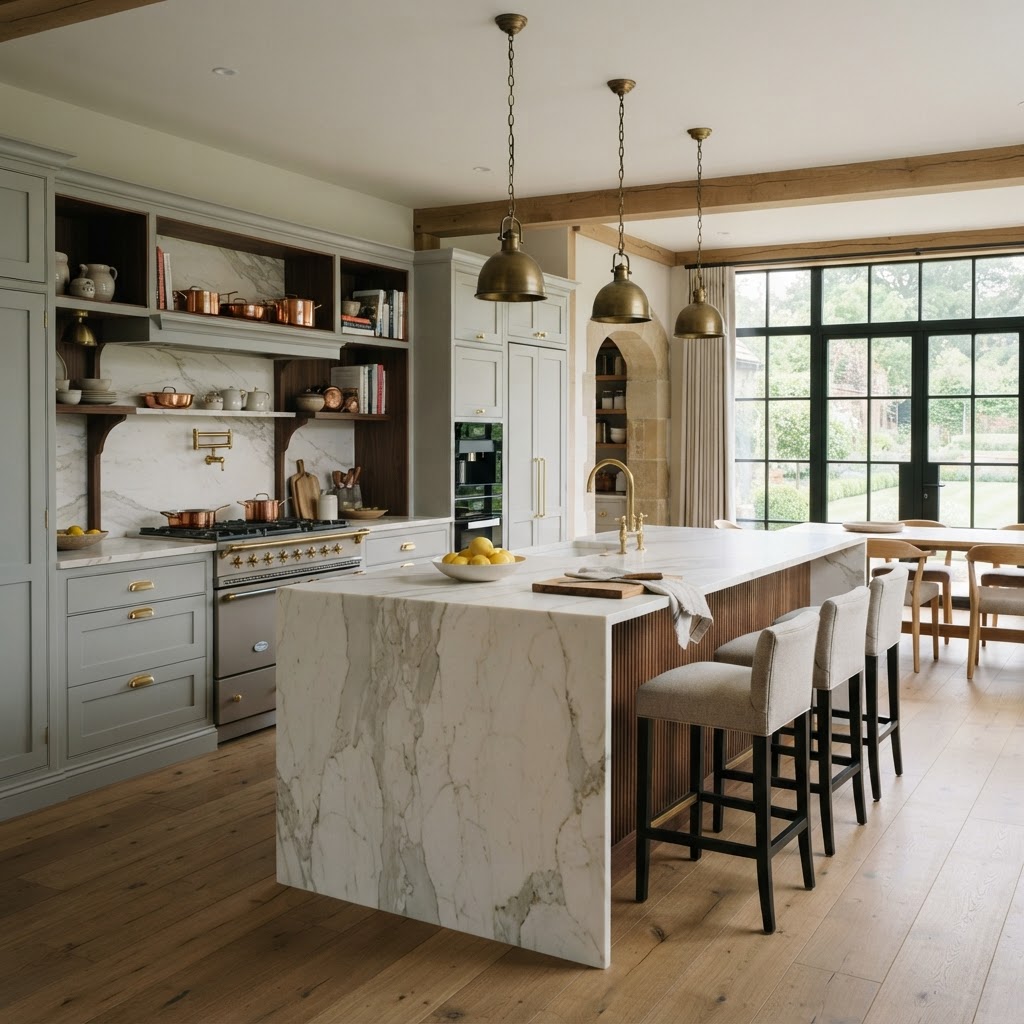
The End of the Extractor Hood as We Know It
For decades, the extractor hood loomed over the kitchen hob like an architectural obligation — a necessary intrusion that designers learned to tolerate, disguise, or at best, celebrate. But in 2026, the most forward-thinking luxury kitchens are doing something altogether more radical: removing it entirely.
The rise of induction hobs with fully integrated downdraft extraction has quietly become one of the most significant shifts in high-end kitchen design in a generation. It is a change that is as much about philosophy as it is about technology — a pursuit of the truly seamless, the elegantly uncluttered, the kitchen that disappears into the architecture of a home rather than competing with it.
At Dajon Interiors, our team of bespoke kitchen designers has been watching this evolution closely. As Gloucestershire's premier luxury interiors showroom, we work with clients across Gloucester, Cheltenham, Stroud, and the wider Cotswolds who demand kitchens that are as visually pure as they are technically accomplished. And nothing achieves that balance quite like an induction hob with integrated extraction.
How Integrated Extraction Hobs Actually Work
The principle is elegantly simple, even if the engineering behind it is anything but. Rather than capturing steam, grease, and cooking odours as they rise toward a canopy above, integrated extraction hobs draw air downward — directly at the source. Powerful fans housed beneath or within the hob itself pull vapours down through a filtration system, either recirculating cleaned air back into the kitchen or expelling it externally through ductwork.
The result is extraction that is, in many cases, more efficient than a traditional overhead hood — particularly for high-heat cooking where steam and smoke rise quickly. Because the extraction point is immediately adjacent to the cooking surface, there is far less opportunity for odours to disperse into the wider room before being captured.
Recirculation vs. External Ducting
There are two approaches to integrated extraction, and the right choice depends on your kitchen's layout and your home's structural possibilities. External ducting — where extracted air is vented outside the property — offers the most powerful and permanent solution, and is generally preferred in new-build or full renovation projects where ductwork can be planned from the outset. Recirculation systems, which filter and return air internally, offer greater flexibility for retrofitting and can be highly effective when equipped with high-quality activated carbon filters.
For clients undertaking a full bespoke kitchen project — as many of our Dajon Interiors portfolio commissions involve — external ducting is almost always the preferred route. It offers superior performance, lower long-term maintenance, and the cleanest possible result.
The Design Freedom This Technology Unlocks
Ask any luxury kitchen designer what a single change most transforms a cooking space, and the answer is almost always the same: remove the overhead hood. The visual impact is extraordinary. Suddenly, the full height of a kitchen — its cabinetry, its ceiling detail, its architectural bones — becomes visible and uninterrupted. In open-plan living spaces, which continue to define aspirational home design across the Cotswolds and beyond, this matters enormously.
Without a hood dominating the eye line above the hob, designers gain the freedom to do something genuinely exciting with that space. A beautifully lit run of upper cabinetry. A statement splashback in handcrafted ceramic or rare natural stone. An unbroken expanse of joinery that carries the eye from floor to ceiling. These are the moments that elevate a kitchen from a functional room to a work of considered design — and they are precisely the moments that define the bespoke kitchens we create at Dajon Interiors.
Island Kitchens: Where Integrated Extraction Truly Shines
The kitchen island has become the centrepiece of modern luxury home design, and it presents a specific challenge when it comes to extraction. A ceiling-mounted hood above an island is technically effective but visually dominant — it hangs in the middle of a room, interrupting sightlines and, in open-plan spaces, creating a visual barrier between kitchen and living areas.
Integrated extraction solves this entirely. An island hob with built-in downdraft extraction sits flush and clean, unencumbered by anything above it. From the living area, the kitchen island reads as a pure, sculptural form — a slab of stone or a run of fine joinery — rather than a cooking station with industrial apparatus overhead. It is, in the truest sense, the invisible kitchen.
Materials, Finishes, and the Luxury Detail
The hob itself, freed from the visual competition of an overhead hood, becomes a design element in its own right. The finest integrated extraction hobs feature flush-mounted induction zones in tempered glass or brushed stainless steel, touch or gesture controls that leave the surface uninterrupted by dials or buttons, and extraction grilles crafted with a precision that speaks of serious engineering intent.
These are products that reward close inspection — the kind of details that clients who invest in truly bespoke kitchens come to appreciate over years of daily use. At Dajon Interiors, we curate our specification choices with exactly this longevity in mind, selecting technology that will feel as current and as capable in a decade as it does today.
The surrounding design — cabinetry, worktop, splashback, flooring — can then be chosen entirely on aesthetic merit, without the need to accommodate or disguise extraction infrastructure. For clients working with natural stone worktops in Calacatta marble or dramatic quartzite, or with hand-painted cabinetry in bespoke colours, this freedom is invaluable.
Practical Considerations for Homeowners
As with any significant kitchen investment, there are practical questions worth exploring before committing to integrated extraction. The most important is ventilation: your kitchen designer should assess whether external ducting is feasible, and if so, plan the routing carefully to ensure it does not compromise structural elements or create noise issues.
Maintenance is straightforward — filters require periodic cleaning or replacement, and the hob surface itself is as easy to clean as any standard induction unit. The absence of an overhead hood, with its grease-collecting surfaces and filter cartridges, is, for many homeowners, a welcome reduction in cleaning obligation.
Power and connectivity requirements should be discussed early in the design process. Integrated extraction hobs typically require a dedicated electrical circuit, and in island configurations, cable routing through the island structure needs to be planned carefully. These are all considerations that an experienced bespoke kitchen designer — as our team at Dajon Interiors routinely handles — will address as a matter of course.
Designing the Invisible Kitchen Across Gloucestershire
The homes of Gloucestershire present a wonderfully diverse canvas for this kind of design thinking. From Georgian townhouses in Cheltenham's celebrated Regency terraces to converted barn homes nestled in the Cotswolds countryside, from contemporary new builds in Gloucester's expanding residential neighbourhoods to characterful stone cottages in Stroud's hillside villages — each setting brings its own architectural identity and its own design opportunities.
In the grand open-plan kitchen-diners that define so many Cotswolds renovation projects, the visual lightness of an integrated extraction hob is transformative. The kitchen becomes part of the room's wider composition rather than a self-contained functional zone, and the cooking island anchors the space without dominating it.
In Cheltenham's period properties, where ceiling heights are generous and architectural detailing is celebrated, the removal of a hood allows cornicing, pendant lighting, and cabinetry proportions to be fully appreciated. For clients investing in luxury kitchens Cheltenham-wide, this is often the detail that makes the difference between a beautiful kitchen and an extraordinary one.
Across Stroud and the surrounding villages, where clients often blend contemporary design sensibilities with a respect for the character of older buildings, integrated extraction offers a way to introduce the very latest technology without any visual intrusion on the fabric of the home. The kitchen feels current and considered, without feeling incongruous.
Our portfolio of completed projects across Gloucestershire demonstrates how powerfully this approach translates across different home types and design briefs. Whether you are planning a full kitchen transformation or refining an existing space, the principles of the invisible kitchen — technology in service of pure design — offer something genuinely exciting.
Is an Integrated Extraction Hob Right for Your Kitchen?
The honest answer is that for the vast majority of clients planning a high-end kitchen in 2026, integrated extraction deserves serious consideration. The technology is mature, the performance is proven, and the design benefits are profound. The principal constraint is practical — the need for adequate ventilation planning — rather than aesthetic or functional.
If you cook with high heat regularly, enjoy Asian-style cooking with significant wok use, or have a kitchen where external ducting is genuinely impractical, a recirculation system with premium filtration may be preferable to a less powerful integrated unit. Your kitchen designer should help you assess your specific cooking habits and spatial constraints honestly, so that the specification chosen truly serves your lifestyle.
At Dajon Interiors, we believe that the best luxury kitchen is not the one with the most impressive specification list, but the one that fits its owners' lives most precisely — aesthetically, practically, and emotionally. The invisible kitchen, at its finest, achieves exactly that.
Visit Dajon Interiors: Gloucestershire's Luxury Kitchen and Interiors Showroom
If the idea of a kitchen without visible extraction — a space of pure, uninterrupted design — resonates with you, we would love to explore what that might look like in your home. Our showroom in Gloucester brings together the finest in bespoke kitchen design, luxury bathroom creation, and beautifully crafted bedroom furniture, all under one roof and all informed by decades of expertise in high-end interiors across Gloucestershire.
Our designers work closely with clients from the first conversation to the final installation, combining technical knowledge with a genuine passion for design to create spaces that exceed expectations. Whether you are early in your thinking or ready to begin in earnest, a visit to our showroom is the natural place to start.
Begin Your Bespoke Kitchen Journey Today
The invisible kitchen is not a trend — it is a design philosophy, and one whose time has genuinely arrived. If you are planning a kitchen renovation or new build project in Gloucester, Cheltenham, Stroud, the Cotswolds, or anywhere across Gloucestershire, Dajon Interiors is ready to help you realise something exceptional.
Contact our team today to arrange a showroom visit or a design consultation. We look forward to showing you what is possible when technology and design thinking work in perfect harmony.