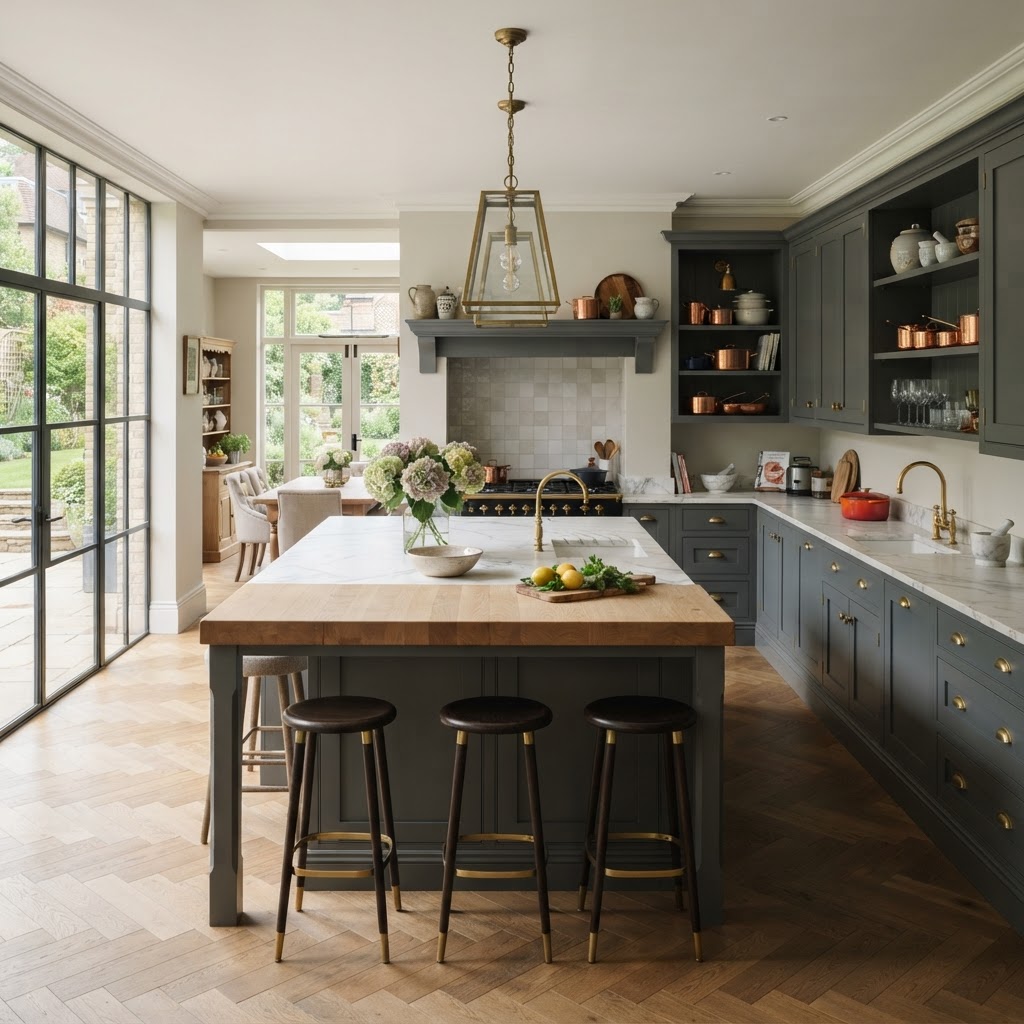
When a Kitchen Becomes More Than a Room
There is a moment — if you have ever stood inside a truly exceptional kitchen — when you stop thinking about the room at all. The cabinetry recedes into the background. The worksurfaces feel like a natural extension of your hands. The layout anticipates your every move. Nothing jars, nothing distracts, and nothing feels out of place. What you are experiencing is not simply good design. It is the result of hundreds of considered decisions, made with precision, purpose, and an unwavering commitment to quality.
This is the standard that separates a fitted kitchen from a genuinely bespoke one — and it is the standard that drives every project at Dajon Interiors, our luxury kitchen and interiors showroom in Gloucester. In a world increasingly saturated with off-the-shelf solutions and design-by-algorithm aesthetics, the truly considered kitchen stands apart as something rarer and far more rewarding.
In this guide, we explore what it actually means to design a kitchen with intention — from the philosophy behind great spatial planning to the materials, finishes, and details that elevate a kitchen from functional to extraordinary.
The Foundation: Spatial Intelligence Before Style
It is tempting, when designing a new kitchen, to begin with the aesthetic. A particular door finish catches your eye. A shade of grey feels quietly luxurious. A handleless profile looks sleek and contemporary. These are all valid starting points for inspiration — but they should never be the foundation of a design.
The foundation of a great kitchen is spatial intelligence: an honest, rigorous understanding of how you actually use the space, how you move through it, and how it must serve the rhythms of your daily life. A kitchen designed around your real behaviour will always outperform one designed around a trend.
The Work Triangle — and Why It Is Still Relevant
The classic ergonomic principle of the kitchen work triangle — connecting the hob, sink, and refrigerator — has been discussed, debated, and declared obsolete countless times. And yet, in practice, its underlying logic remains sound. The principle is not about rigidly connecting three fixed points; it is about minimising unnecessary movement between the zones where most kitchen activity takes place.
In a modern bespoke kitchen, this thinking evolves into a more nuanced zone-based approach: a preparation zone, a cooking zone, a cleaning zone, and increasingly, a social zone — the area where family and guests naturally gather, whether around an island, a breakfast bar, or an open-plan dining space. Designing these zones with intention, ensuring they flow naturally into one another without conflict, is the invisible architecture of a truly great kitchen.
Cabinetry: The Art of the Carcass
Ask any experienced kitchen designer what separates a luxury kitchen from a mid-range one, and the conversation will quickly turn to what you cannot see. The doors and drawer fronts are what first catch the eye, but it is the construction quality of the carcass — the structural body of every cabinet — that determines how a kitchen performs over the years and decades ahead.
In a high-end bespoke kitchen, carcasses are built to exacting tolerances, typically from high-density moisture-resistant board or solid timber depending on the design specification. Internal fittings — drawer boxes, pull-out larder units, corner solutions — are constructed with the same precision, running on soft-close mechanisms engineered to operate thousands of times without degradation.
Door Profiles and the Language of Luxury
The door profile is the face of a kitchen — the first visual impression and the detail that most clearly communicates a kitchen's character and quality. In 2026, the breadth of available profiles spans from the razor-sharp geometry of J-pull and integrated-handle designs to the warm, tactile richness of frame-and-panel doors with hand-painted finishes.
What unites the finest examples across all styles is the quality of the finish itself: the depth of colour in a lacquered door, the grain consistency across a veneer panel, the precision of a mitred corner. These are the details that distinguish a truly bespoke kitchen from one that merely looks the part at first glance.
Worksurfaces: Where Beauty Meets Daily Life
Few elements of a kitchen are as tactile, as functional, or as visually defining as the worksurface. It is the canvas on which daily life plays out — and in a luxury kitchen, the choice of material is never arbitrary.
Natural Stone
Marble remains the enduring icon of kitchen luxury: its veining unique to every slab, its cool surface ideal for pastry work, its aesthetic unmistakably sophisticated. Calacatta, Statuario, and Carrara each offer distinct character, from the bold drama of gold-veined Calacatta to the quieter, more restrained elegance of Carrara. It is worth noting that marble, while beautiful, requires sealing and considered maintenance — a reality that only adds to its appeal for those who appreciate materials that develop a patina with use.
Quartzite — a natural stone often confused with quartz — offers comparable visual drama with greater hardness and resistance to etching, making it an increasingly popular choice for those who want the look of marble with marginally more forgiveness in daily use.
Engineered Quartz and Porcelain
For those who require performance without compromise, engineered quartz and large-format porcelain slabs offer extraordinary durability alongside a remarkable breadth of aesthetic options. The finest engineered surfaces now replicate the movement and depth of natural stone with a consistency and predictability that suits larger kitchen projects where matching across multiple slabs is essential.
Colour, Finish, and the Palette of Restraint
In luxury kitchen design, the most sophisticated colour choices are rarely the most obvious ones. The kitchens that endure — that look as compelling in ten years as they do on the day of completion — are typically built on a foundation of restraint: a considered, limited palette where every tone has been chosen for its relationship to natural light, to the surrounding architecture, and to the materials alongside it.
Soft, chalky whites and warm off-whites continue to define a particular strand of timeless kitchen design, particularly suited to the stone buildings and country houses of the Cotswolds. Equally compelling are the deeply saturated greens — from sage and olive to forest and bottle — that feel simultaneously contemporary and deeply rooted in the British landscape. Navy and slate blues carry a quiet authority, particularly beautiful when paired with unlacquered brass hardware and natural stone.
The interplay between matt and gloss finishes adds a further dimension of sophistication: a matt lacquered door alongside a polished stone worksurface creates a textural contrast that is far more interesting than any single finish could achieve alone.
Hardware: The Jewellery of the Kitchen
Hardware occupies a curious position in kitchen design — simultaneously among the smallest details and among the most significant. A handle, a tap, a hinge: these are the elements you touch every day, the details that communicate quality in the most direct and immediate way.
In a bespoke kitchen, hardware is never an afterthought. The weight of a handle in your hand, the arc of a tap's spout, the finish of a cabinet knob against a painted door — these decisions are made deliberately and in relation to every other element of the design. Unlacquered brass ages beautifully alongside natural materials. Brushed nickel offers clean, contemporary restraint. Matte black makes a bold graphic statement, particularly effective against pale cabinetry.
Lighting: The Detail That Changes Everything
A kitchen can be designed with perfect proportions, exceptional materials, and flawless cabinetry — and still feel flat and uninspiring without considered lighting. Light is the element that animates a space, that reveals the depth of a stone surface, that softens the geometry of a handleless kitchen, that turns a functional room into somewhere you genuinely want to spend time.
In a luxury kitchen, lighting is designed in layers: ambient light for general illumination, task lighting precisely positioned over worksurfaces and hob, and accent lighting to highlight architectural features, open shelving, or glass-fronted cabinetry. Under-cabinet lighting, when specified correctly, is transformative — casting a warm wash across a worksurface that makes the kitchen feel alive at any hour of the day or evening.
Designing for Gloucestershire Homes
The homes of Gloucestershire present some of the most compelling and characterful contexts for kitchen design in England. From the Georgian townhouses of Cheltenham's Montpellier quarter to the honey-stone farmhouses of the Cotswolds, from the Victorian villas of Stroud to the new-build family homes developing across the wider county — each presents its own set of opportunities, constraints, and inspirations.
Designing a kitchen for a period property in Cheltenham demands a different sensibility to designing one for a contemporary open-plan extension in Stroud. The proportions of the room, the quality of natural light, the architectural language of the building — all must inform the design process from the very beginning. This is where working with a local studio that genuinely understands the built environment of Gloucestershire makes a profound difference.
At Dajon Interiors, our knowledge of the homes and clients of this region is built over years of delivering completed projects across Gloucester, Cheltenham, the Cotswolds, and the wider county. Whether you are renovating a listed farmhouse, extending a family home, or designing an entirely new build, we bring a depth of local understanding that a national brand or online retailer simply cannot replicate. Our kitchen design service is tailored from the very first conversation to your home, your life, and your vision.
Visit Dajon Interiors: Gloucestershire's Luxury Kitchen Showroom
Understanding what makes a bespoke kitchen truly exceptional is one thing. Experiencing it is another entirely. There is no substitute for standing in a fully dressed kitchen display, opening drawers, touching surfaces, and seeing how light falls across materials at different times of day. It is in the showroom that a design moves from concept to conviction.
Our showroom in Gloucester brings together the finest in bespoke kitchen, bathroom, and bedroom design — a carefully curated environment where every display has been designed to inspire and inform. Whether you are at the very beginning of a project or looking to refine an existing brief, our team of expert designers are here to guide you through every decision, from spatial planning to the final choice of hardware.
We work with clients across Gloucestershire — from Cheltenham and Stroud to the villages of the Cotswolds — and we would love to hear about your project. Get in touch with us today to arrange a showroom visit or a design consultation. A considered kitchen begins with a considered conversation.
Conclusion: The Kitchen You Will Never Want to Leave
The very best kitchens share a quality that is almost impossible to quantify but immediately recognisable: they feel inevitable. As though every decision — every proportion, every material, every detail — could not have been made any other way. This is the result not of luck or trend-following, but of genuine design expertise applied with patience and precision.
At Dajon Interiors, this is the standard we hold ourselves to on every project. Because a kitchen is not simply a room in your home. It is the room where your home begins.