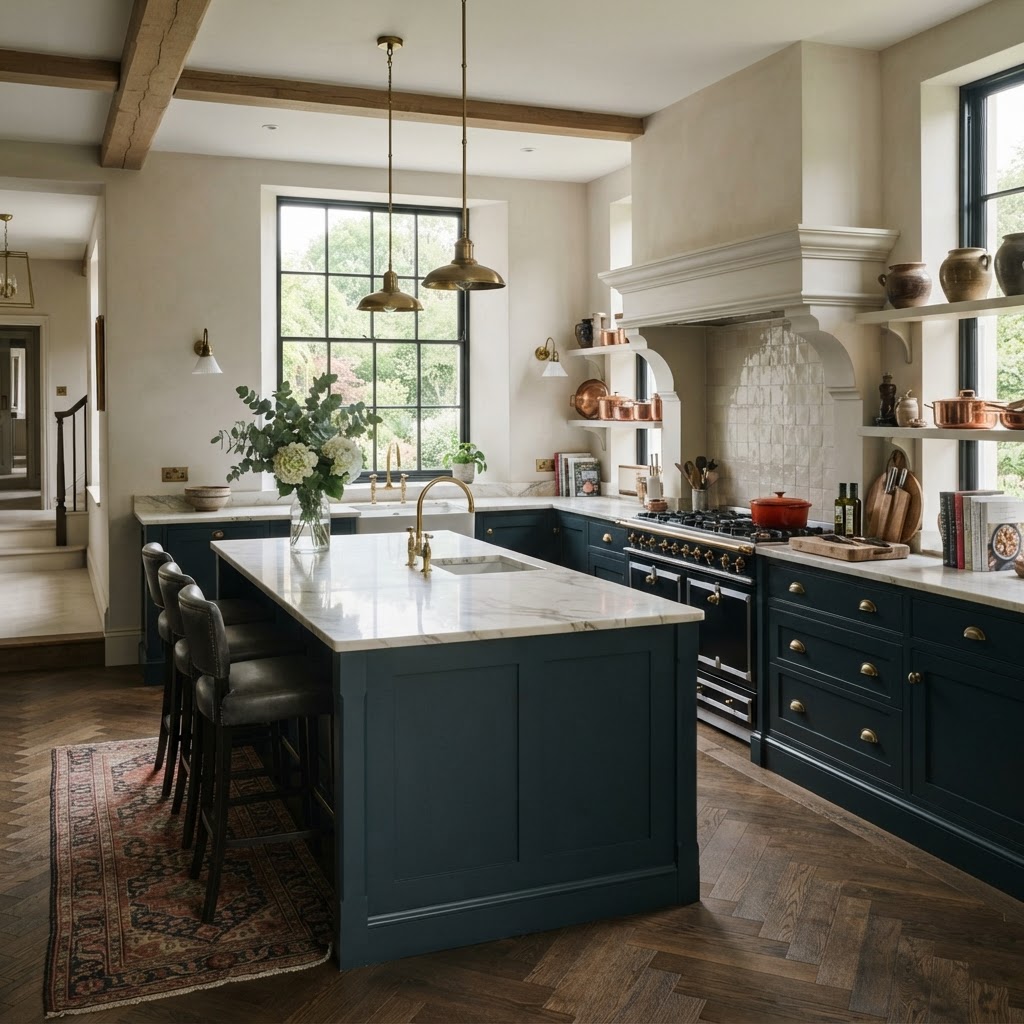
The Kitchen That Disappears — and Dazzles
There is a quiet revolution taking place in the most coveted kitchens across the UK. It is not loud, it is not ostentatious, and that, precisely, is the point. The luxury kitchen of 2026 is one that conceals its own brilliance — where the most sophisticated technology sits flush with the worktop, where extraction happens invisibly, and where every surface flows without interruption from one end of the room to the other.
This is the age of the invisible kitchen: a space engineered to feel effortless, to perform flawlessly, and to look, above all else, like a work of considered art. At Dajon Interiors, we have been designing and installing bespoke luxury kitchens across Gloucestershire for years, and we have never seen appetite for this level of refined understatement quite so strong as it is right now.
What Is the Invisible Kitchen?
The term does not mean a kitchen that literally disappears — though on some days, after a dinner party, one might wish it could. Rather, it describes a philosophy of design in which the functional elements of a kitchen — hobs, extractors, appliances, storage — are integrated so seamlessly into the overall scheme that the room reads first and foremost as a beautiful living space, not a utilitarian one.
At its heart, this movement is driven by three converging forces: advances in induction cooking technology, the development of downdraft and in-hob extraction systems, and a broader cultural shift towards open-plan living, in which the kitchen must be as visually serene as the sitting room it flows into.
The Induction Hob: Precision, Purity and Performance
The modern induction hob has come a very long way from its early incarnations. Today's premium induction surfaces are virtually indistinguishable from the worktop itself when not in use. Finished in black glass or even surfaces that mimic stone, they lie completely flat, with controls that illuminate only when needed and then fade back into the material beneath.
The performance credentials are equally impressive. Induction cooking is faster, more energy-efficient and more precise than gas or ceramic alternatives. Heat is generated magnetically within the pan itself rather than radiating outward, which means the hob surface around the cooking zone stays cool to the touch — a significant safety advantage, particularly in family homes.
The very finest induction systems now offer full-surface flexibility, meaning the entire hob is one continuous cooking zone. Pans can be placed anywhere across the surface and the system detects and responds to them automatically. For those who cook seriously — or simply enjoy the theatre of cooking — this represents a genuinely transformative experience.
Integrating Induction into Your Worktop Design
One of the great design advantages of induction is how naturally it lends itself to flush installation. With the right worktop material — Dekton, Neolith, premium quartz or engineered stone — the hob can be recessed to sit perfectly level with the surrounding surface, eliminating the visual break that a traditional framed hob creates. The result is a worktop that runs in one uninterrupted plane from wall to wall, a detail that speaks quietly but powerfully to quality.
Downdraft Extraction: The End of the Overhead Hood
If the induction hob is the hero of the invisible kitchen's cooking zone, then the downdraft extractor is its most dramatic supporting act. Rather than capturing cooking vapours by drawing them upward through a hood suspended above the hob, downdraft systems extract air downward — either through the worktop immediately behind or beside the hob, or directly through a system integrated into the hob surface itself.
The implications for kitchen design are profound. Without the need for an overhead canopy or ceiling-mounted hood, sight lines remain completely open. Island units — already one of the most sought-after features in luxury kitchen design — can be positioned freely without the visual weight of an extractor above them. Vaulted ceilings, structural beams, and statement pendant lighting can all coexist with serious cooking performance in a way that simply was not possible before.
In-hob extraction takes this a step further still, incorporating the extraction mechanism directly within the hob unit itself. The result is a single, beautifully resolved component that handles both cooking and ventilation in one seamless piece of engineering. These systems are particularly well suited to the refined, pared-back aesthetic that characterises the best luxury kitchens today.
Ventilation Performance: What to Consider
It is worth noting that downdraft and in-hob extraction systems require careful specification to ensure adequate performance. Extraction rates, duct routing, and the type of cooking you do most frequently all influence which system is right for your kitchen. At Dajon Interiors, our design team works closely with clients to specify extraction solutions that perform as beautifully as they look — never compromising one for the other.
Concealed Appliances and Handle-Free Cabinetry
The invisible kitchen extends beyond the hob and extractor. Refrigerators, dishwashers, ovens and wine coolers are increasingly specified behind fully integrated cabinet doors, their presence revealed only when you need them. When every appliance is concealed behind a consistent door front — whether that is a tactile matt lacquer, a warm wood veneer, or an elegant stone-effect finish — the kitchen achieves a visual calm that feels genuinely luxurious.
Handle-free cabinetry amplifies this effect further. Push-to-open mechanisms, J-pull profiles or recessed finger channels allow drawer and door fronts to remain completely uninterrupted. Combined with integrated lighting that activates on opening, the experience of using such a kitchen feels almost ceremonial — every interaction considered and deliberate.
Materials That Support the Invisible Aesthetic
Achieving the invisible kitchen is as much about material selection as it is about technology. The worktop is the star of the show, and in 2026 the finest options continue to be ultra-compact surfaces such as Dekton and Neolith, premium quartzite, and large-format porcelain. These materials share a key quality: they can be specified in large, seamless slabs that minimise joins and maximise visual continuity.
Upstands and splashbacks in the same material as the worktop extend the seamless aesthetic up the wall, particularly effective in full-height runs behind hobs and sinks. Where natural stone is used, book-matched slabs — where two cuts from the same block are mirrored to create a symmetrical veining pattern — add a level of bespoke artistry that no two kitchens can replicate.
Cabinetry finishes in 2026 lean heavily towards depth and texture: deep forest greens, rich charcoal, warm taupe, and the enduring appeal of natural oak and walnut veneers. These are colours and materials that feel grounded and timeless, designed to anchor a space rather than trend-chase — the hallmark of truly considered luxury.
Designing the Invisible Kitchen in Gloucestershire
Across Gloucestershire, the appetite for this level of kitchen design is unmistakable. In Cheltenham, where period townhouses and Regency crescents meet contemporary interior ambitions, the invisible kitchen has become the gold standard for renovation projects: a way of introducing cutting-edge technology and modern aesthetics without disrupting the architectural character of the home.
In the Cotswolds, where stone farmhouses and rural retreats set a very specific design context, the invisible kitchen brings a welcome modernity that never feels at odds with its surroundings. Warm cabinetry tones, natural stone worktops and discreet technology allow these kitchens to feel both ancient and entirely current at once.
In Stroud and the surrounding villages, where a strong appreciation for craft and considered design runs deep, our clients consistently seek kitchens that are as intelligent as they are beautiful — spaces that have been thought through thoroughly and built to last. And in Gloucester itself, ambitious renovation projects and new builds alike are embracing the invisible kitchen as the defining residential interior statement of the decade.
If you are exploring our completed projects, you will see this philosophy at work across a wide range of homes and budgets — each one unique, each one unmistakably Dajon Interiors.
Is the Invisible Kitchen Right for You?
The invisible kitchen is not a single product or a single style. It is a philosophy — one that prioritises calm over clutter, integration over addition, and long-term elegance over short-term novelty. It suits open-plan living spaces where visual continuity matters. It suits those who entertain regularly and want a kitchen that transitions seamlessly between workspace and social space. And it suits anyone who simply believes that the finest things in life should work without effort and look without trying.
That said, the invisible kitchen does require careful planning. Technology choices, extraction routing, worktop thickness, appliance specification — these are all decisions that benefit enormously from expert guidance at the earliest possible stage of a project. This is precisely why visiting a specialist showroom before committing to any decisions is so valuable.
Visit Dajon Interiors: Gloucestershire's Luxury Kitchen Showroom
At Dajon Interiors, our showroom in Gloucester brings the invisible kitchen to life in a way that no website or brochure can replicate. You can experience the precision of flush induction surfaces, understand the quiet efficiency of downdraft extraction, and work directly with our design team to explore how these principles might translate into your own home.
Whether you are planning a full kitchen renovation in Cheltenham, designing a new build in the Cotswolds, or simply beginning to explore your options across Gloucestershire, we would love to be part of your journey. Visit our kitchen design pages to see the full range of styles and finishes we offer, browse our completed projects for inspiration, or explore our bespoke bathroom and luxury bedroom collections if you are considering a wider home transformation.
Book your design consultation today by visiting our showroom or getting in touch via our contact page. Our team is ready to help you design a kitchen that disappears into beauty — and stays with you for a lifetime.
Conclusion: The Most Sophisticated Kitchens Are the Ones You Cannot See
The invisible kitchen represents the pinnacle of contemporary luxury kitchen design. It is a space that asks nothing of you visually, that performs everything you require technically, and that rewards you every day with the quiet pleasure of living inside something truly well made. As induction technology continues to advance and extraction systems grow ever more refined, this design language will only deepen and evolve — but its core principle will remain unchanged: that the best design is the kind you feel rather than see. At Dajon Interiors, that principle informs everything we do.