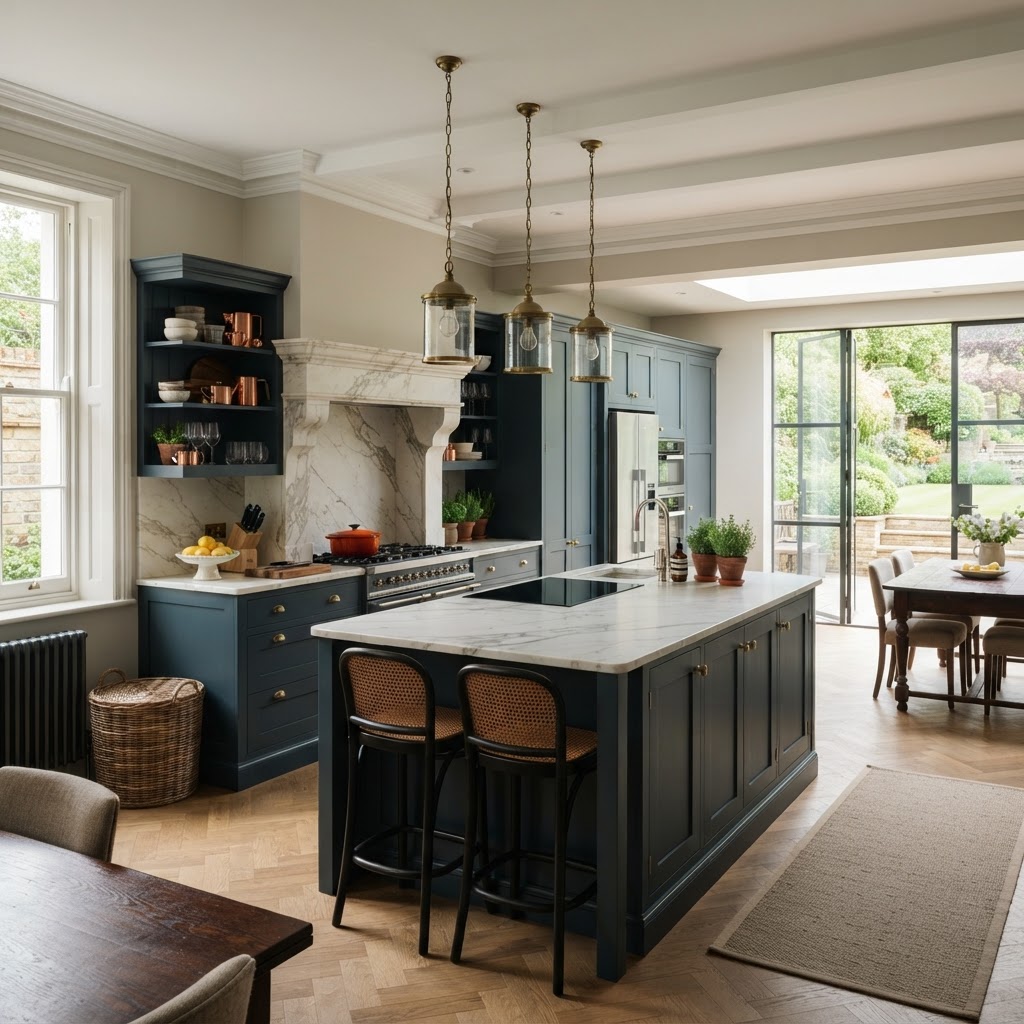
The Cooktop Reimagined: Where Performance Meets Flawless Design
There is a quiet revolution happening at the heart of the modern luxury kitchen. For decades, the cooktop and the extractor hood existed as separate, often visually competing elements — the hob sitting flush on the worktop, the hood looming overhead, dominating sightlines and interrupting the architecture of a carefully considered space. In 2026, that compromise is over.
Flush induction hobs with integrated downdraft or in-hob extraction have fundamentally changed what is possible in kitchen design. They represent the convergence of precision engineering and pure aesthetics: a seamless cooking surface that draws steam, vapour and cooking odours away quietly and efficiently, without a single suspended canopy in sight. The result is a kitchen that feels open, uncluttered and genuinely spectacular — a space that is as pleasurable to inhabit as it is to cook in.
At Dajon Interiors, we have been watching this shift with great interest, and increasingly, our clients across Gloucestershire are asking us to incorporate this technology into their bespoke kitchen projects. It is not difficult to understand why.
What Are Flush Hobs with Integrated Extraction?
At their simplest, these are induction cooking surfaces built to sit perfectly level with the surrounding worktop, combined with an extraction system that is either housed within the hob unit itself or positioned immediately adjacent to it at worktop level. Rather than pulling air upwards through an overhead hood, they draw cooking fumes downwards or horizontally across the surface, filtering and expelling them through ducting concealed within the cabinetry or island structure beneath.
The engineering involved is considerable. The extraction must be powerful enough to manage the steam produced by high-heat cooking, yet quiet enough not to intrude on the atmosphere of an open-plan kitchen and living space. The best systems achieve both with remarkable success — operating at a whisper while delivering genuinely effective ventilation.
Induction technology is the ideal partner for this approach. Unlike gas, induction produces no combustion byproducts, meaning the extraction system only needs to manage moisture and cooking vapour rather than carbon monoxide or nitrogen dioxide. The cooking zones themselves heat instantly and cool rapidly, with precise temperature control that suits everything from a delicate beurre blanc to a rapid sear.
The Design Case: Why This Changes Everything
Uninterrupted Sightlines
In an open-plan kitchen — which remains the dominant layout in high-end new builds and renovations across the Cotswolds and beyond — the overhead extractor hood has always been an aesthetic challenge. Even the most beautifully crafted statement hoods, in brushed steel or bespoke colour finishes, draw the eye and anchor the space in a particular way. Remove the hood entirely, and something remarkable happens: the ceiling opens up, natural light moves more freely, and the kitchen becomes a genuinely fluid part of the wider living environment.
For island kitchens in particular, the effect is transformative. An island with a flush hob and no overhead structure above it has an elegance that is very difficult to achieve any other way.
A Worktop That Flows Without Interruption
When the hob sits truly flush — glass surface level with stone, ceramic or sintered worktop on either side — the kitchen takes on an almost architectural quality. The worktop reads as a single unbroken plane, and the cooking zone becomes something revealed only when it is in use. Between meals, the surface is simply beautiful.
This is especially relevant for the premium worktop materials our clients favour: book-matched marble, large-format sintered stone, honed granite. These are surfaces chosen for their visual impact, and a flush hob allows them to be appreciated in their entirety rather than interrupted by an appliance frame.
Cleaner, Quieter Cooking
Beyond aesthetics, there is a practical intelligence to in-hob extraction that experienced cooks quickly appreciate. Because the extraction happens at the source — immediately adjacent to or within the cooking zone — it captures steam and vapour before it has the chance to rise and disperse. This means more efficient ventilation, less condensation on surfaces, and a kitchen that remains fresher during and after cooking.
Combined with the rapid, responsive nature of induction, the overall cooking experience becomes markedly more controlled and enjoyable.
Materials, Finishes and Integration
The finest examples of this technology are designed to disappear into the kitchen rather than announce themselves. Glass surfaces in dark graphite or warm champagne tones are most common, chosen to complement both light and dark cabinetry palettes. Controls are increasingly minimal — touch-sensitive strips or recessed dials that maintain the visual calm of the surface when not in use.
Integration with the surrounding cabinetry is key to achieving the full effect. The ducting and motor housing must be accommodated within the island or run unit beneath, which requires careful planning from the earliest stages of a kitchen project. This is not a product that can easily be retrofitted into an existing design; it demands to be considered as part of the whole, which is precisely why it suits the bespoke approach that defines our work at Dajon Interiors.
Worktop selection also becomes even more important when planning around a flush hob. The material must be cut and finished with absolute precision to achieve the seamless join that makes the concept work visually. Stone fabricators with experience of this detail are essential, and it is something we coordinate closely on every relevant project through our established network of specialist craftspeople.
Is This Technology Right for Your Kitchen?
Flush induction hobs with integrated extraction are an exceptional choice for the right kitchen — but they are not universally appropriate, and part of our role at Dajon Interiors is to help clients make genuinely informed decisions rather than simply follow trends.
They suit open-plan layouts particularly well, especially where the cooking zone is positioned on an island or peninsula. They work beautifully in kitchens where the visual brief prioritises calm and restraint. They are ideal for clients who cook regularly and want a surface that is straightforward to clean and maintain.
They may be less suited to very high-volume cooking environments where extraction demands are extreme, or in kitchens where gas remains preferable — though the number of clients requesting gas in new luxury kitchen projects has fallen significantly in recent years, a trend we expect to continue as induction technology becomes increasingly sophisticated.
Luxury Kitchens Across Gloucestershire: A Region Embracing Design Excellence
Across Gloucester, Cheltenham, Stroud and the wider Cotswolds, the appetite for genuinely considered, design-led kitchens has never been stronger. We are seeing clients invest more thoughtfully in their homes — not simply updating appliances or cabinetry in isolation, but approaching the kitchen as a complete architectural project, one that reflects their lifestyle and their aesthetic values in equal measure.
In Cheltenham, the prevalence of generous Regency townhouses with open lower ground-floor plans makes island kitchens with statement cooking zones a natural choice. In the Cotswolds, where interior schemes often draw on natural materials — stone, limed oak, aged brass — the visual restraint of a flush hob complements the palette beautifully. In Stroud and the surrounding villages, where design sensibility tends towards the considered and the crafted, integrated extraction fits naturally into kitchens that value function and beauty in equal proportion.
Dajon Interiors works with clients across all of these areas, and our experience of designing luxury kitchens in Gloucestershire means we understand not just the aesthetic ambitions of our clients, but the practical realities of their homes — the ceiling heights, the floor plans, the light. These details matter enormously when specifying a system like this, and they inform every recommendation we make.
If you are considering a kitchen renovation and would like to explore whether flush induction with integrated extraction is the right choice for your space, we invite you to browse our completed projects for inspiration, and to visit us in person to see working examples and discuss your brief in detail.
Visit Dajon Interiors: Experience the Future of Luxury Kitchen Design
There is a significant difference between reading about flush induction hobs and standing in front of one, running your hand across the uninterrupted worktop surface, watching the glass heat instantly and cool to the touch moments later. It is the kind of product that earns its price through experience rather than specification sheets.
Our showroom in Gloucester is designed precisely to offer that experience — a space where you can explore the full range of kitchen, bathroom and bedroom possibilities available through Dajon Interiors, and where our design team can begin to understand what you are looking for and how we might achieve it.
Whether you are at the earliest stages of considering a kitchen project or ready to begin the design process in earnest, we would love to hear from you. Get in touch with our team to arrange a showroom appointment, and let us show you what a truly considered luxury kitchen looks like in 2026.
The Quiet Confidence of a Kitchen That Has Nothing to Hide
The best luxury kitchens are not necessarily the most dramatic. They are the ones that have been thought through completely — where every decision, from the profile of the cabinet door to the routing of the extraction ducting, has been made with care and intention. Flush induction hobs with integrated extraction embody that philosophy precisely: they represent complexity in service of simplicity, technology deployed not to impress but to liberate.
At Dajon Interiors, that is the kind of design thinking we bring to every project. We believe that the most satisfying kitchens are the ones that become quietly indispensable — spaces you use every day with genuine pleasure, that look as beautiful at breakfast as they do at a dinner party, and that continue to feel right years after they were installed. That is the standard we hold ourselves to, and we look forward to achieving it with you.